
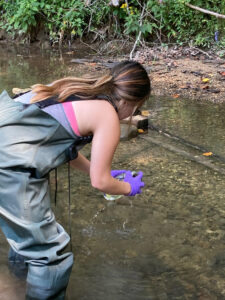
Gunpowder Riverkeeper has welcomed Johns Hopkins Graduate student, Jenn Galler, to our water quality monitoring program. Jenn wrote the following article on microplastics and their relevance to water bodies and the Gunpowder River. Read more about Jenn’s work here.
 Microplastics are just what they sound like: tiny plastic particles that result from both commercial product development and the breakdown of larger plastics. They are less than 5 mm in length and almost invisible to the human eye. Now there are even nanoplastics that are much smaller and researchers think to be more toxicologically active than microplastics. Since the Industrial Revolution plastic production has been on the rise and now it’s everywhere we look. It took off for its convenience, affordability, and practicality, but designed to be single use. Plastic doesn’t just disappear, through time and degradation plastic simply just breaks down into smaller and smaller pieces, which also means that every piece of plastic ever produced is still here but in different forms. So you see how this has become such a huge problem?
We’ve probably all heard about the 5 garbage patches in the middle of the oceans that consist mostly of plastic waste. Well that plastic waste has a trickle down effect on not only the health of our oceans, but the fish and wildlife that will consume the microplastics and ultimately to us who eat the fish or swim in the oceans.
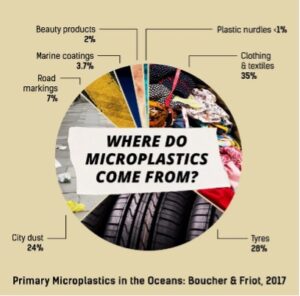
On a more local level, microplastic pollution is happening in our local waterways in sneakier ways. When I did microplastic research at the University of Tennessee, Knoxville, we took water and invertebrate samples of the TN river, urban creeks, and rural creeks to see what types of and how many microplastic particles were lurking in our waterways. What we found was surprising, it wasn’t just the plastic waterbottles and food packing that we all think of first. It was microplastic particles from our clothing when we wash it; the water from our laundry goes into our waterways and significantly pollutes it.
There are ways to prevent or decrease this water pollution:
1. Don’t buy fast fashion.
2. Buy second hand clothing made out of natural materials like wool, hemp, bamboo, silk, and cotton. The worst materials are polyester and nylon.
3. Do laundry less often and make sure it is full when you do.
4. Avoid delicate settings on your machine.
5. Line-dry your clothes when possible.
6. Consider installing a filter on your washing machine or using a laundry bag or laundry ball.
Now at Gunpowder RIVERKEEPER® we are looking to do our own microplastic research to identify what microplastics are lurking in the Gunpowder River and how we can prevent this here locally.
