
Wednesday December 17th, Blue Water Baltimore’s Sarah Holter and Dri DeLuca made the trip up from the city to Sparks Bank Nature Center for a day of collaboration and water quality monitoring on the Little Falls. They brought with them their YSI, Aquafluor, and a wealth of knowledge from their monitoring programs that Gunpowder RIVERKEEPER® was eager to learn from as we gear up to apply for our Chesapeake Monitoring Cooperative Tier III approval for nontidal and tidal sites in 2026.
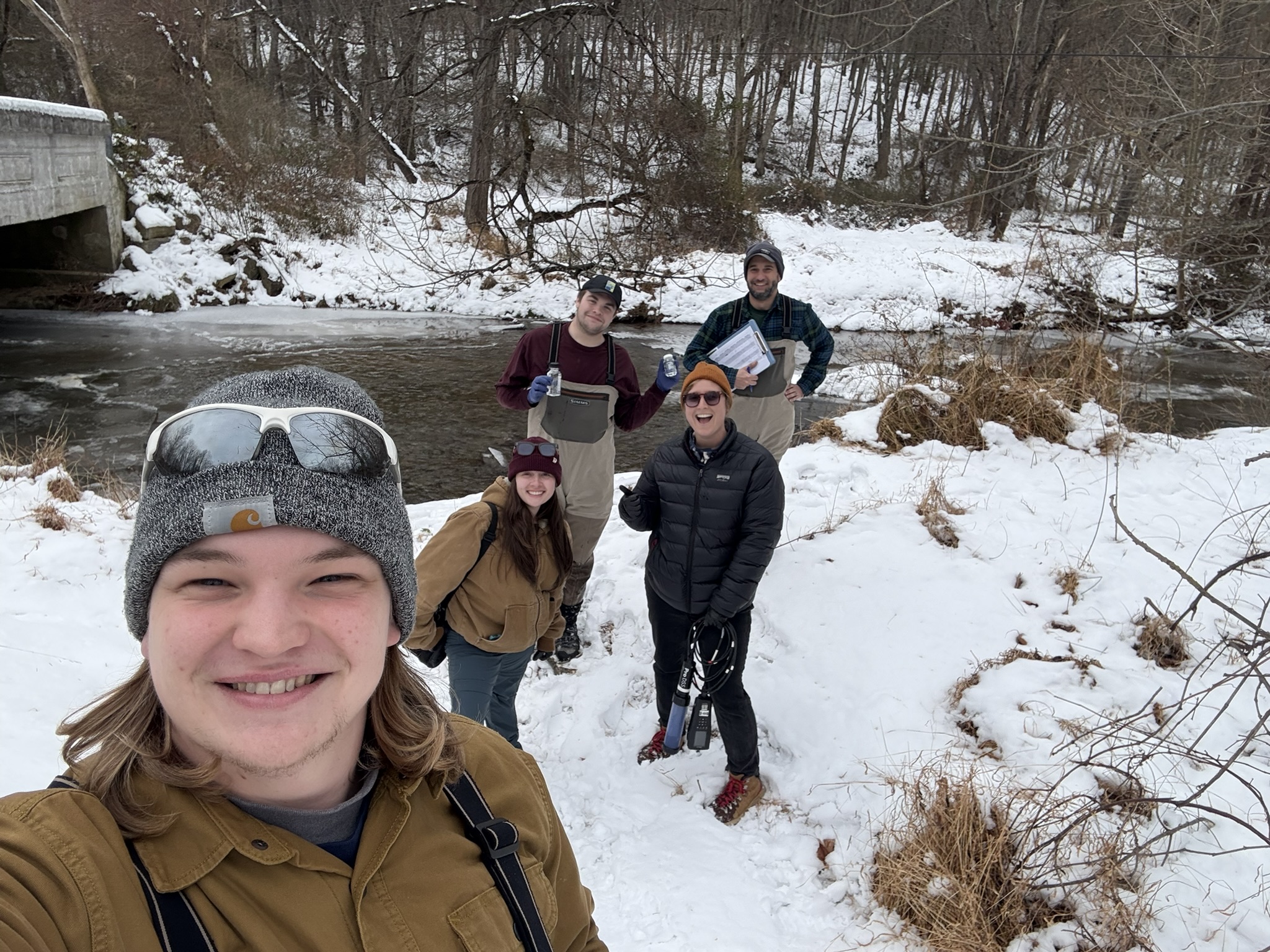
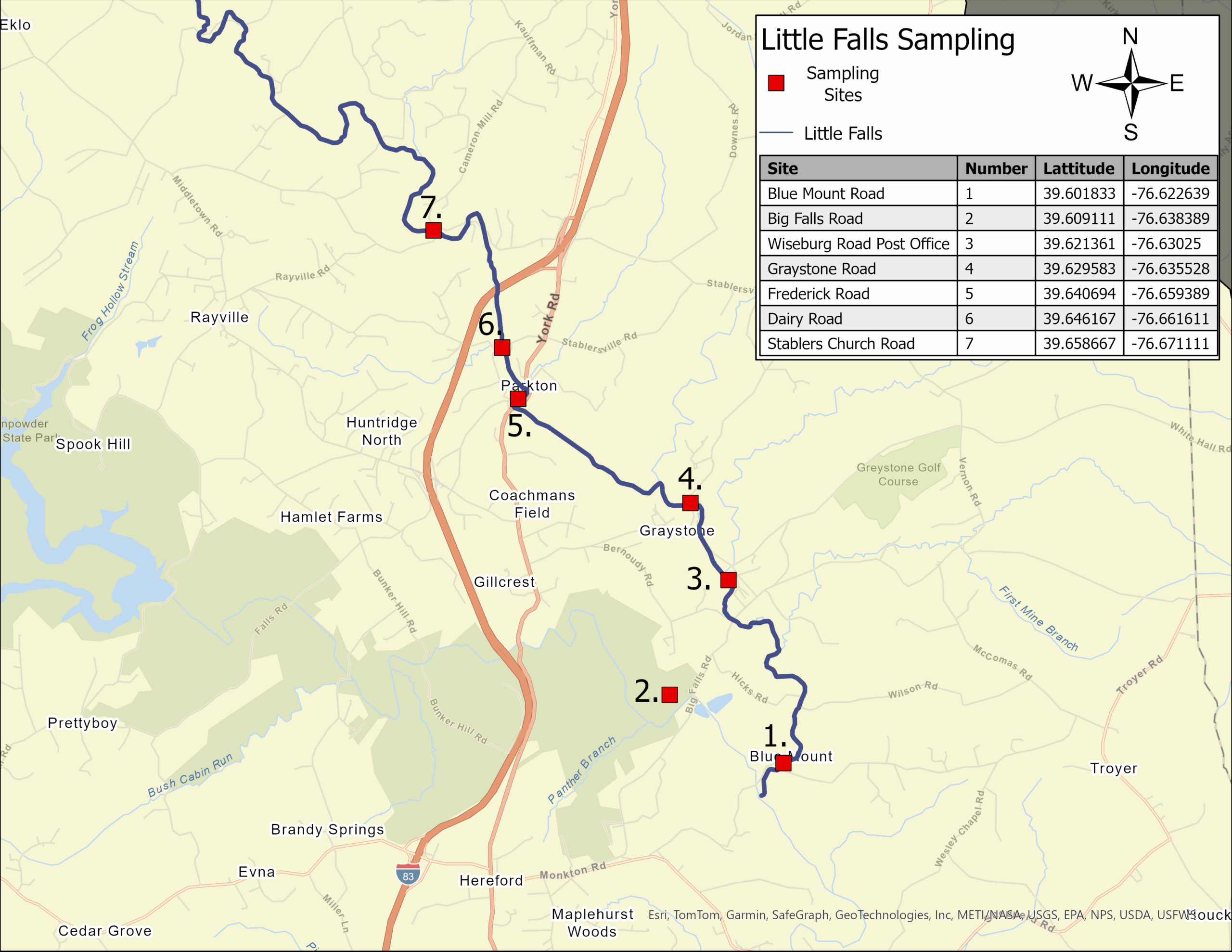
After a brief tour of the Nature Center and a doughnut, Brady Bayne, Tristan McGregor, and Joe Ottomano set off to the first of seven monitoring locations selected and mapped by Brady the day prior.
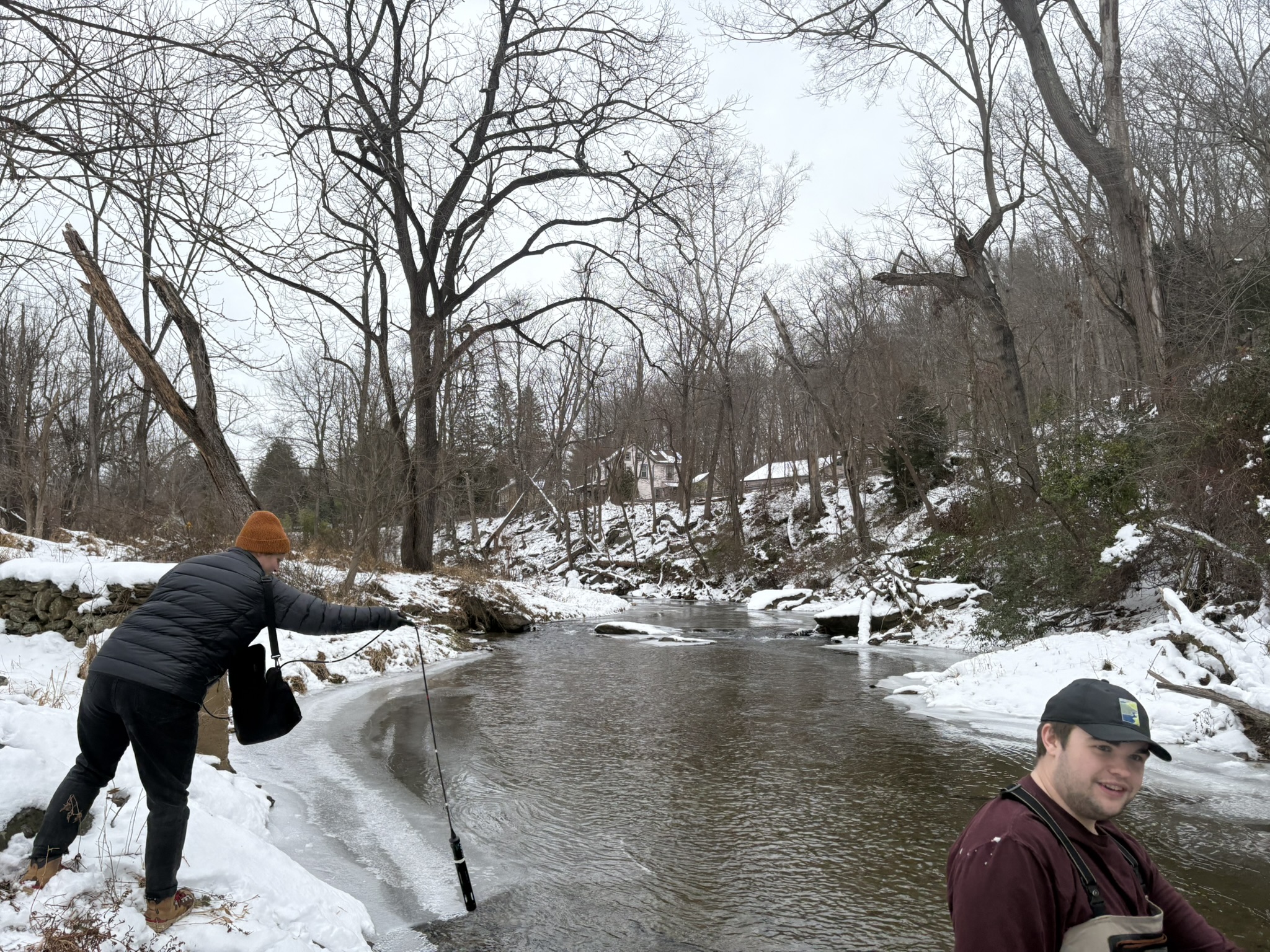
Armed with our sampling bottles and equipment, we arrived at a pull-off on Blue Mount Road to find the lot still covered in snow from last weekend’s storm. Undeterred, we pressed on to gather our samples and to take readings with the YSI and Aquafluor machines. We measured water temperature, barometric pressure, dissolved Oxygen, Conductivity, pH, and turbidity with the YSI probe all of which are indicators of water quality.
With the Aquafluor, we filled a cuvette with a small sample of water to determine the concentration of optical brighteners. These common additives in laundry detergents and other products are a key indicator that septic leakage is occurring in a watershed. Gunpowder RIVERKEEPER® is interested in pursuing this method to identify possible sources of contamination. We were fortunate to find amounts no larger than 3.5 parts per million, or less than 20% of the concentration that Blue Water Baltimore would report as a level of concern.

Along with the quantitative measurements, we noted the quality of the banks, bank stability, benthic sediment type, and other notable features such as a large outfall beneath the Big Falls bridge, the flood plain behind the White Hall post office, and the Owl Branch tributary feeding Little Falls just above our sample site.

After collecting our data and samples at all seven sites, and giving one of the cars just a couple pushes to get out of the snow, we returned to the Nature Center to test our samples for NaCL (Sodium Chloride, aka: salt) in parts per million for the Izaak Walton League Salt Watch and for harmful bacteria in the laboratory using the IDEXX Method (Be part of the Salt Watch: request your free salt watch kit HERE).
| Site Location | Air Temperature (F°) | Water Temperature (C°) | Optical Brightners (PPM) | Barometric Pressure (mmHG) | Dissolved Oxygen (%) | Dissolved Oxygen (mg/l) | Conductivity (mS/cm) | Turbidity (FNU) | pH (Units) |
| Blue Mount | 41 | 0.1 | 2.52 | 753 | 101.4 | 14.34 | 262.5 | 1.5 | 7.76 |
| Big Falls | 41 | 2.4 | 3.523 | 751.9 | 103.4 | 14.17 | 214.2 | 2.01 | 8.16 |
| Post Office | 41 | 0.4 | 2.435 | 751 | 103.6 | 14.98 | 263.4 | 1.59 | 8.02 |
| Graystone | 41 | 0.1 | 2.457 | 750.5 | 104.2 | 15.2 | 272.2 | 1.57 | 7.39 |
| Frederick | 41 | 0.4 | 2.47 | 748.6 | 103.3 | 19.93 | 277.2 | 1.33 | 7.88 |
| Dairy | 41 | 0.5 | 2.96 | 7.983 | 103.6 | 14.95 | 259.3 | 1.27 | 7.33 |
| Stablers | 45 | 0.1 | 2.204 | 745.1 | 102.3 | 14.92 | 238.6 | 2.4 | 7.88 |
Juliette Verderaime, our Youth Climate Institute member, was lucky enough to find time in her schedule to help us with the last of the samples, but once they were sealed in Quanti-Trays and set into the incubator, there was nothing left to do but wait until the next day to see how many cells fluoresced under the ultraviolet light to indicate the presence of E. coli. Results came in 18 hours later all within safe parameters for swimming, or ice-fishing, as it were.
As always, feel free to stop by the Sparks Bank Nature Center most Tuesdays-Saturdays 9-4 if you want to learn more about the work Gunpowder RIVERKEEPER® does to protect the Gunpowder Watershed and thanks to our downstream neighbors at Blue Water Baltimore for their invaluable time, experience, and all of the work their organization does to keep our waters clean.
