
Friday March 13th Gunpowder RIVERKEEPER® staff Brady Bayne and Joe Ottomano and volunteers Tristan McGregor and Steve Duker attended training to become certified stream monitors for benthic macroinvertebrates.

The training was hosted by Patapsco Heritage Greenway’s Mandy DeLeo and Allison LeBlanc who are certified trainers through the Izaak Walton League of America.

Benthic (bottom-dwelling) macroinvertebrates (relatively big bugs) are a key indicator of water quality. Certain insect species have larval stages that live in water until they mature. These larvae can be found in most waterbodies including streams, small creeks, and even backyard puddles. Some species like mayflies only spend a few months in the water before emerging as adults while dragonfly larvae can take almost 2 years to mature. Because these organisms live in the stream for long periods of time, they can be used as indicators of the water quality.
Some species such as caddisflies, mayflies, stoneflies, water snipe flies, gilled snails, water pennies, and riffle beetles are very sensitive to pollution. If a stream boasts large populations of these intervetebrates it is likely not heavily impaired by pollution.

On the other hand, if a stream does contain high populations of leeches, midges, black fly larvae, lunged snails, aquatic worms, and flatworms, it is likely that the water has high levels of pollution as these invertebrates are tolerant of pollutants.


To use the presence or absence of benthic macroinvertebrates as a measure of water quality, we first started by retrieving a sample from the stream. We deployed a kick net below a riffle: a patch of cobblestones, rocks anywhere between the size of one’s fist to the size of one’s head, where water breaks the surface and receives oxygen. In order to standardize sample-size, we isolated a one-square-foot patch of rocks upstream from our net to vigorously agitate for a precise amount of time. Sample duration can last from 20 seconds to 90 seconds and is comprised three-quarters of rubbing and scrubbing cobble to dislodge invertebrates and one-quarter digging into the substrate to unearth burrowing invertebrates. Everything that is collected in the net at the end of the sampling period is delicately carried to a table for inspection and tabulation.

Once the sample is out of the stream, the fun and time-consuming task begins of collecting all of the macroinvertebrates from the net to identify and count. Each insect, mollusc, crustacean, and worm is tweezered, scooped, or pipetted into an ice cube tray to get a better view of what it is and to start organizing by critter-type. Magnifying glasses and microscopes can help get a closer view in order to identify and classify the smallest of the macroinvertebrates.
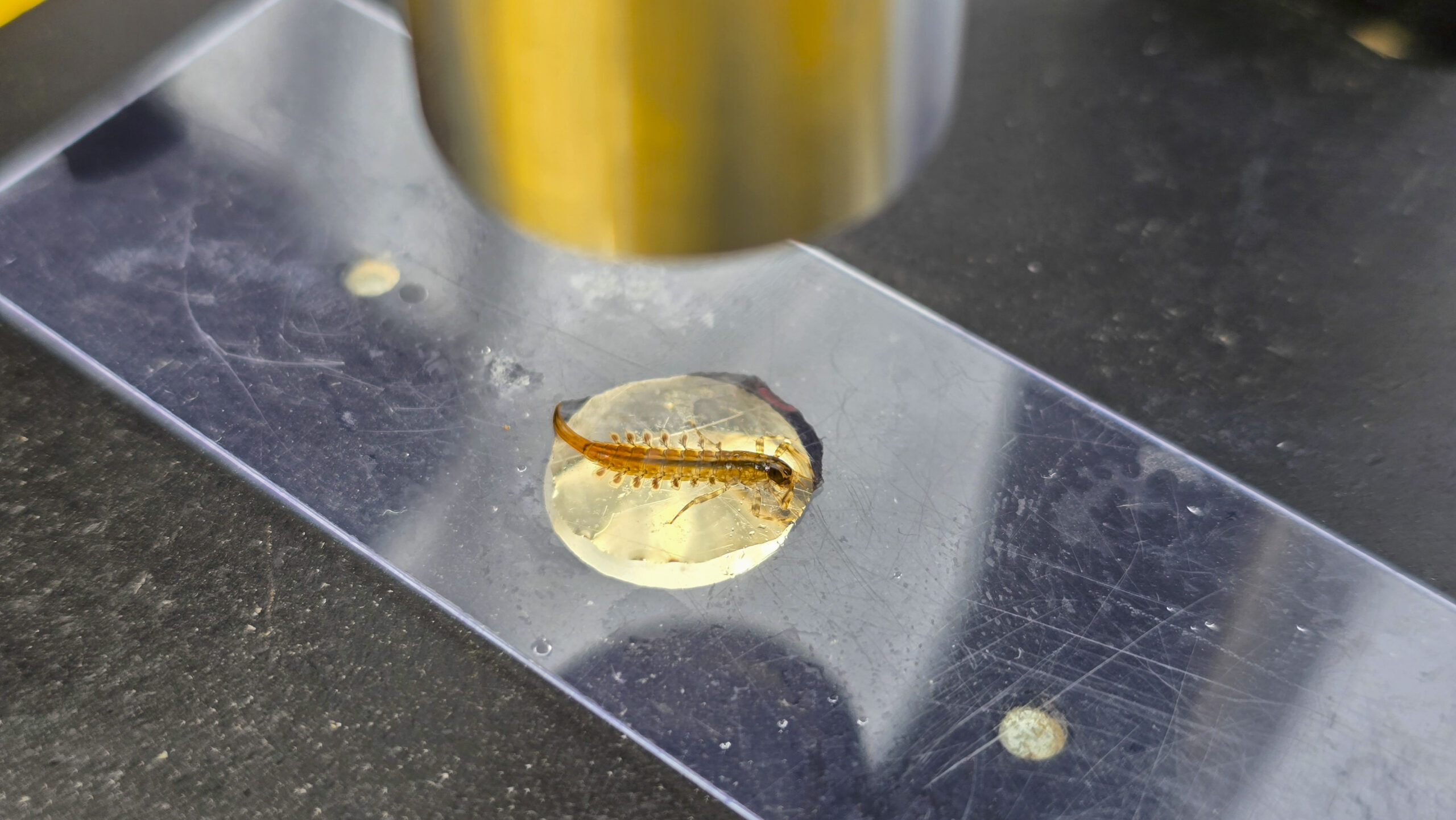
Many of the invertebrates looks rather similar. No one is going to mistake a crayfish for a fly larva, but the flies can be hard to differentiate. Clues include number of legs, tails, gill tufts, wingpads, and protective casings. Luckily we had expert Mandy present to show us which of our caddisflies were casemakers, which were common netspinners, and which were less-common netspinners.

In order for the sample to be representative of the stream population and indicate water quality, no fewer than 200 macroinvertebrates must be sampled. Had we not obtained 200 specimens in our first sample we would have to return to the stream to complete a 90-second sample and maximize our effort to obtain the correct quantity. Up to 4 samples could be completed to obtain those 200 samples. With less than 200, we could still upload our data as an example of a low population, but obtaining 200 specimens is the goal for water quality monitoring.
Once the net is fully picked, five minutes pass without anyone spotting a new bug to sort, the invertebrates are counted and sorted into categories on the data sheet. Stream health is calculated as a function of percentages of “good” bugs versus “bad” bugs and the metric is recorded out of 12 possible points.

Once the tally is completed, the bugs are returned to the riffle from whence they came so as to disturb them as little as possible (and still collect our data).
Now that we’re certified monitors of benthic macroinvertebrates, Gunpowder RIVERKEEPER® can host our own monitoring at our own sample sites. To facilitate this, Brady Bayne has secured funding through the Chesapeake Bay Trust for our own monitoring equipment. Our first group of monitors will be from the Chesapeake Conservation and Climate Corps as we are hopeful to host an “All Hands on Deck” event later this spring.

Thanks to the Izaak Walton League of American, Patapsco Heritage Greenway, Mandy, Allison, and everyone else who attended the training on Friday for a fun and informative, if cold, day in the stream.
Keep an eye out on our website and on social media for opportunities to get involved in water monitoring. We still have several weeks of anadromous fish spawn surveying (sign-up here) and more opportunities to come!