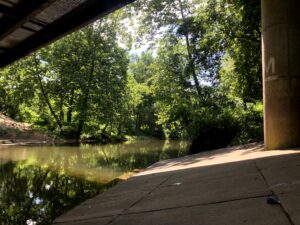
Why Do We Care About PFAS?

Studies have shown a linkage between PFAS exposure and change in liver enzymes, cardiovascular effects (such as high blood pressure or pregnancy-induced hypertension), decreased antibody responses to vaccines, and developmental effects (such as small decreases in birth weight). The EPA has also established PFAS as a possible carcinogen, as there is a link between PFAS …

Read more

What Are PFAS?

PFAS (Perfluoroalkyl and Polyfluoroalkyl substances) are a large group of human-made (synthetic) compounds. They’re an emerging contaminant with minimal state and federal regulation. They are also bioaccumulates, meaning the chemical accumulates gradually over time in organisms, particularly fish. In October 2021, the Maryland Department of the Environment (MDE) issued its first fish consumption advisory based …

Read more

Thank You to Our 2022 Terry Newendorp Scholarship Award Recipients

Gunpowder Riverkeeper greatly appreciates the time and attention Nick Spigler, Dynasty Strickland and Tristan McGregor provided this week! These three Terry Newendorp Environmental Scholarship recipients helped us with containment of invasive species, E.Coli sampling, and PFAS sampling.  Another big thanks to Betsy and Bob for showing us around the Bird and allowing us access to …

Read more

Gunpowder River Water Quality Update June 27, 2022

Gunpowder Riverkeeper is proud to provide up-to-date water quality information to residents of Baltimore and Harford counties along the Gunpowder and Bush River Watersheds.  For a map based on Bacteria Monitoring Results and more information on this monitoring work, please visit: https://gunpowderriverkeeper.org/swim-guide  In partnership with Community Environmental Laboratories, an EPA-certified water testing laboratory located …

Read more

Gunpowder RIVERKEEPER® is Honored to Announce Partnership with Smithsonian Environmental Research Center (SERC) for Monitoring Efforts

Thanks to Bill Temmink for providing us with this narrative. Every day, several NASA satellites circle the globe from the North to the South Pole. As the earth turns, these satellite routes will cross over the entire planet, one swath at a time. Some of these satellites take pictures of the ever-changing waters of the …

Read more